Actual examples of YAKI-IRE (The heat treatment to harden the cutting edge)
"YAKI-IRE" is the heat treatment to harden the cutting edge. Sometimes the word "tempering" is used as same meaning, but it is confusion.
(Please read the bottom of this page, that is an assistance by a customer
who is knowledgeable for it. => confusion)
These are report of hardening work from the forge of our smith.
1) An Osoraku-zukuri tanto with Saka-choji hamon
The blade has been shaped up by filing. Be careful of its curvature.

Then it is washed with ashes to remove fats completely.
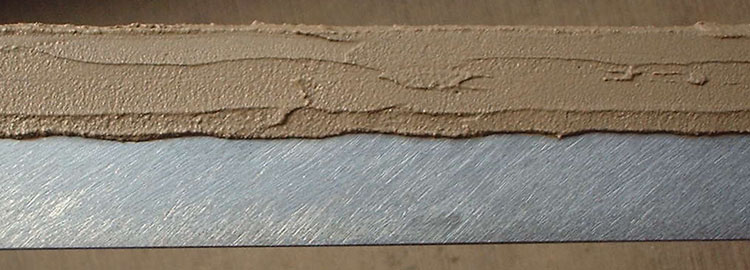
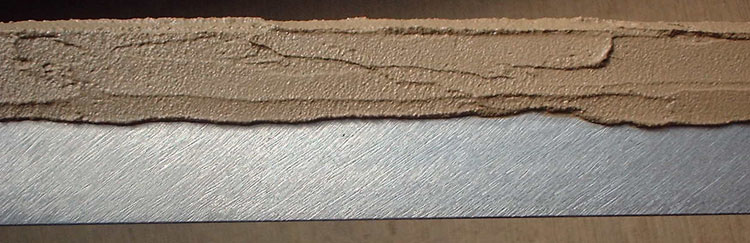
The clay has been put on the blade.
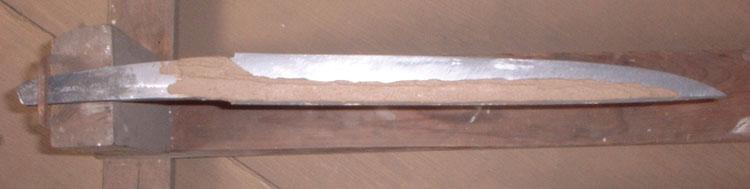
When the clay becomes dry, it is the time of YAKI-IRE.
The smith waits for a silent night. The time has come, the blade is heated
in the forge and then quenched into the water. The area near the cutting
edge is very hardened, and the rest is not so. A little amount of curvature
also appears.
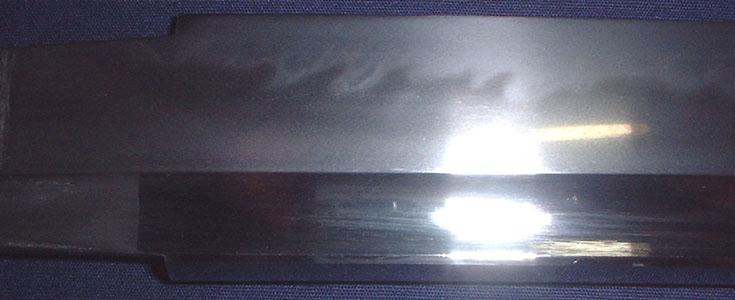
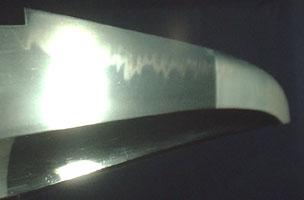
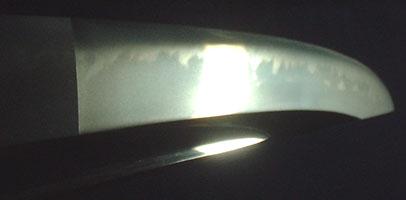
Finish of the blade
The hamon is made of konie (small particles) making saka-choji pattern.
Utsuri also appears.

2) Tachi blades with Komidare/Choji hamon
Two tachi blades are prepared for YAKI-IRE.
The clay work has done.
Tachi #1

Tachi #2

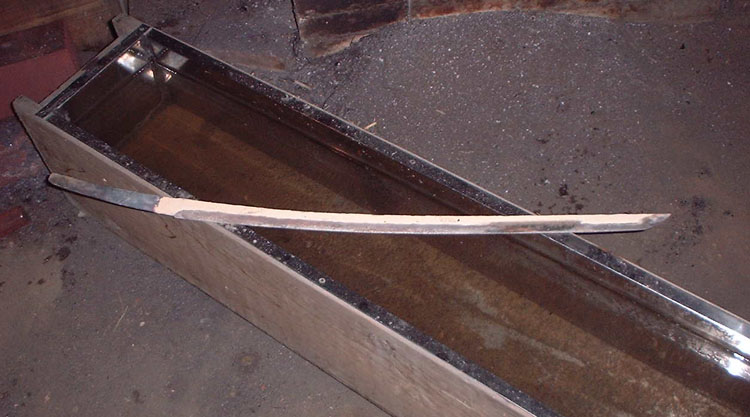
The blade is heated and then quenched into the water.
Tachi #1
The blade just after quenching. A little amount of curvature has occurred.
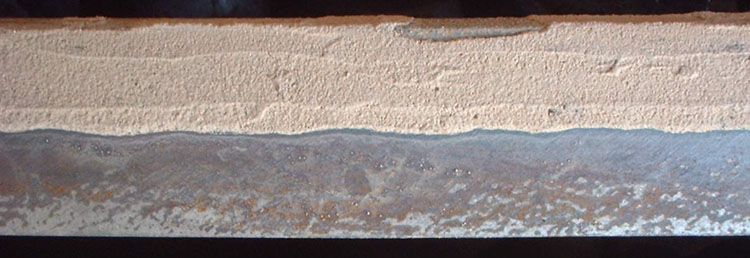
Tachi #2
An immediate polishing has done just after quenching. It is done to remove
the clay and to see the result roughly.
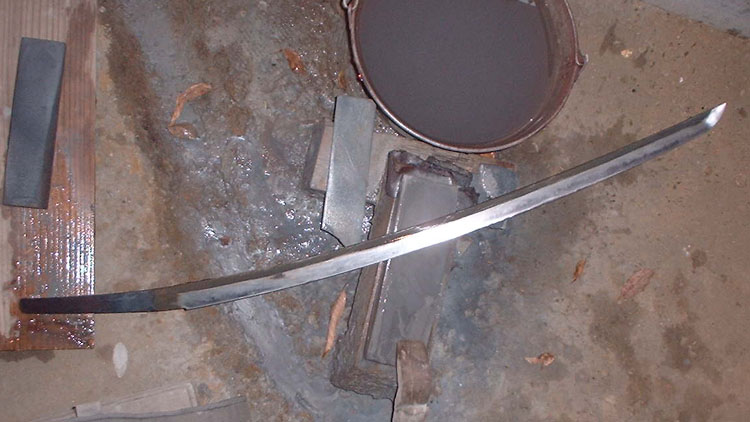
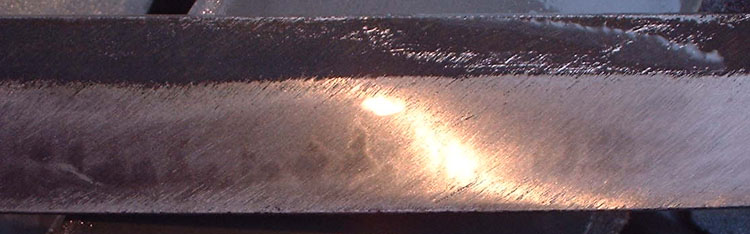
The result of the tempering work
Tachi #1
It has been polished up by the classical style (sashikomi).

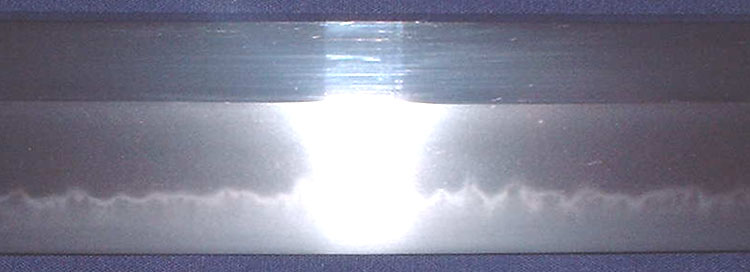

Tachi #2
It has been polished up by the modern style (hadori).

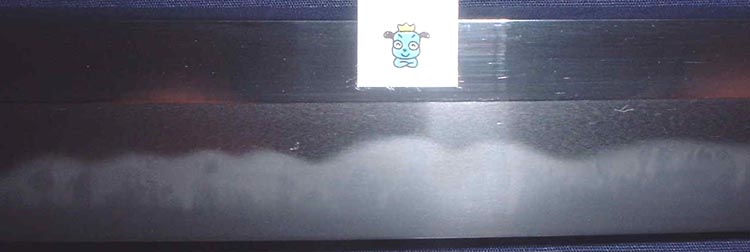

 One customer has sent me some questions for the smith. Then I asked him
the questions.
One customer has sent me some questions for the smith. Then I asked him
the questions.
--------------------------------------------------
An interview to the smith at his forge.
Question; How much carbon content does the blade steel have?
Answer; I don't know, because I have no carbon-counter. Probably the carbon
content is uneven throughout the blade, because it is handmade.
Q; What is the temperature of the blade at yakiire?
A; I don't know. I see only the color of the steel in the fire. The temperature
may be different everywhere on the blade. I can't make an even color throughout
the blade.
Q; Why does the hamon become so active?
A; Please ask steel. I just use it.
---------------------------------------------------
I have found that the smith is just a practical craftsman.
 I have received "Question about Hamon" from a customer.
---------------------------------------------------
When performing yaki-ire, is the edge completely uncoated? No ashi, even?
I am curious because of the beautiful midare and choji hamon that appear
on the sword. I am unfamiliar with a way to accomplish this without the
use of more clay.
---------------------------------------------------
I am afraid if many people confuse that "Every hamon pattern is designed
by the smith who made the blade". Then, I answer.
Our smith doesn't design hamon pattern with clay, in his usual way. The
area near the cutting edge is uncoated with clay. He just use the clay
to suppress the width of hardened area. Any pattern doesn't mean good hamon.
He thinks the brightness of hamon or denseness of hamon particles suggests
the quality of hamon.
Of course, the quality of steel and work of heat treatment is most important
for yaki-ire.
The beautiful midare and choji hamon that appear on the sword our smith
made is not designed by the smith himself. It is designed by the nature,
that among this are, steel, fire and current of water.
In modern age, smiths design hamon patterns with clay, putting ashi or
yo as the questioner mentioned. Master smiths can make it perfectly. I
agree with such a method in order to make an aesthetic blade, even though
our smith can't make them.
In various hamon patterns, some are designed by smith, and some are not
designed. Even in one blade, the hamon pattern can be made both the man-made
elements and the natural coming elements.
(=> Examples of Hamon pattern)
 Good quality of steel and proper Yaki-ire work is necessary to get good
hamon. Good hamon means good quality of the hardened area.
Good quality of steel and proper Yaki-ire work is necessary to get good
hamon. Good hamon means good quality of the hardened area.
There was a customer who wanted the clay I used for yaki-ire. Because, he had tried to make blades by himself, but he didn't get good result on his yaki-ire work. Then I presented him a small amount of the clay, then he tried it. The result of his work was the same to before.
If he needed a magic clay that can make any hamon patterns, my clay was
shit.
Confusion of the word "temper"
We have received an assistance from a customer about the term of "Temper".
-----------------------------------------------------
This is sometimes very difficult, but I am sure that you will understand it. To "temper" steel actually means to soften it after the cutting edge has been hardened. The smith does the tempering to prevent the rest of the knife/sword to be too brittle. In Japanese swords, shingane is used to create a softer center of the knife/sword. It causes the steel to be flexible, yet with a sharp edge. In European swords, the same metal is used in the whole sword, but the back of the blade (usually the whole length of the shinogiji) is heated again, and becomes soft. Thereby the sword is still flexible, but stays sharp at the edge.
Nowadays, "tempering" in the common language refers to the whole
process: the hardening and the softening. It is because many people do
not know the difference, and just say "temper" when they actually
mean "harden". Some smiths and other people with knowledge still
use "temper" when they mean "soften". I hope this may
helped you.
-------------------------------------------------------
In some European swords also, several metals are used to construct a sword.
(=> European Mediaeval Swords)
Home > Information, Smithing > Actual example of Yaki-ire