Examples of Hamon pattern
At first, I have to say again that Hamon pattern is not a matter for blade
quality. Difference of hamon pattern means just a difference of pattern,
never mean difference of quality. To learn various type of hamon patterns
is interesting and useful for Kantei game. But we must not forget blade
quality.
(back to => HAMON)
Hamon pattern is not designed by smith in the early days of Japanese sword.
They used clay to suppress the hardened area, but not to design its pattern.
They needed just a good quality cutting edge on blades. Good steel and
good hardening work calls a bright hamon on it, and makes various patterns.
The patterns come naturally from the relation between fire, water, and
steel quality. People appreciated the patterns naming each of them. Those
naturally comming patterns are suguha, ko-midare, choji, hitatsura, and
some others. They are the hamons those we appriciate most.
(=> Actual examples of YAKI-IRE)
An example of appreciating hamon pattern, Mikazuki Munechika in 11th century
This blade is made by Munechika, and nicknamed "Mikazuki Munechika".
Mikazuki means crescent. The reason why nicknamed so is some crescent patterns
apppeare on the hamon. The appearance comes very naturally, but characterizes
this blade. This blade is recognized as masterpiece by its quality, not
by the hamon pattern. The unique hamon pattern is just a matter of nickname.
The beginning of designed pattern may be ko-gunome or kataochi-gunome that
started in Bizen province in 13th century. We find a small amount of such
pattern in the hamon of Kageyasu blades (brother of Mitsutada). He might
be one of the first smiths who put some design onto hamon intentionally.
Two generations later, the kataochi-gunome was sophisticated as a well
ordered pattern by Kagemitsu.
Then, notare (wavy) pattern was developed by Kanemitsu in 14 century. In
this time, to put some design onto hamon might be a popular method by some
smiths. But such designed hamons still include much non-designed activities
in its patterns.
Later, according with the age becomes modern, the people's interest on
the hamon slowly moved toward its design more than its quality. Finally,
in Shinto period, the aesthetic hamon design got a peak as Tohran-ba by
Sukehiro. In that age, battle fields were far from people's mind. Of course,
good quality steel is necessary to make good designed hamon.
It is a paradox, the hamon pattern becomes cheaper according with people
conscious it as art. It is the important point to think what Japanese sword
is. Someone said it is a millennium decline.
SUGUHA = straight pattern
Suguha can be classified into several kinds, mainly by the width of the
hamon area. Hoso-Suguha = narrow suguha, Chu-suguha = medium suguha, Hiro-suguha
= wide suguha.
Suguha is one of the oldest patterns of hamon. But it includes some amount
of natural irregular patterns. A perfect straight pattern is rare
in the early times of swords.
CHU-SUGUHA (by Aoe school in 14th century)

CHU-SUGUHA (by Taema school, 14c.)
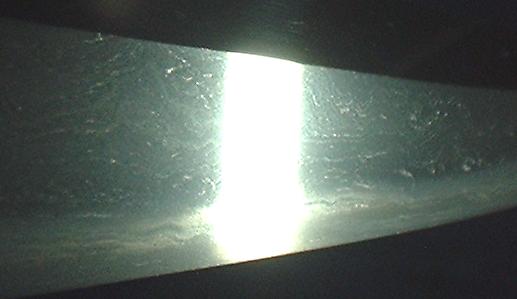
HOSO-SUGUHA
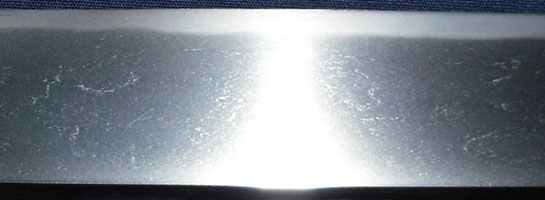
HIRO-SUGUHA (by Tadayoshi, Hizen 17c.)

MIDAREBA = active pattern
Midareba can be classified again into many kinds, because old Japanese
has put a poetical name to each of different patterns.
KO-MIDARE = slightly active (by Naohiro)
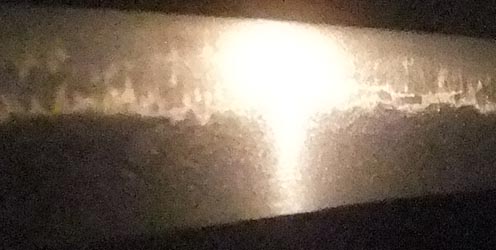
Komidare is also one of the oldest hamon pattern. The Ko-Bizen school (12th
- 13th century) is very famous for it.
GUNOME = zigzag (by Kaneuji, 14c.)
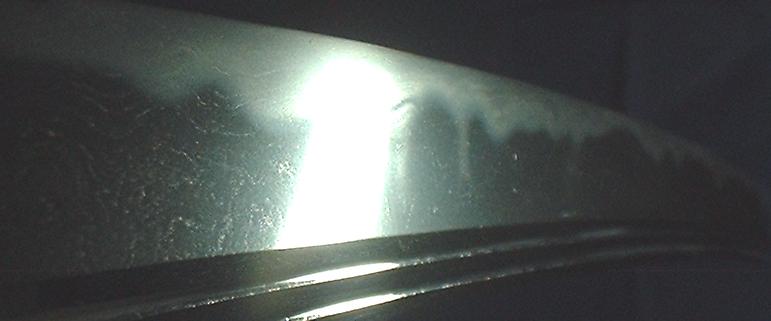
GUNOME (Mino 16c.)
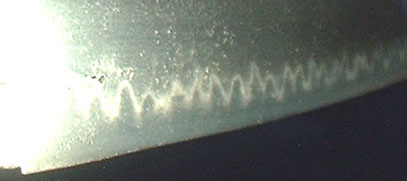
GUNOME (by Osafune school, 16c.)
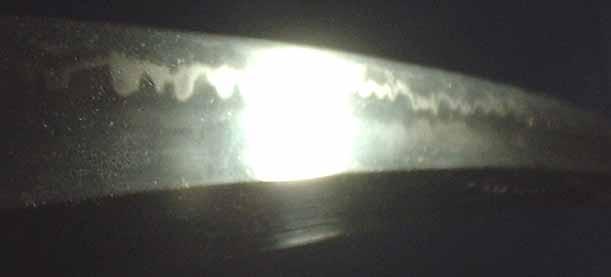
GUNOME (by Fujiwara Masayuki, Takada school, 17c.)

GUNOME (19c.)
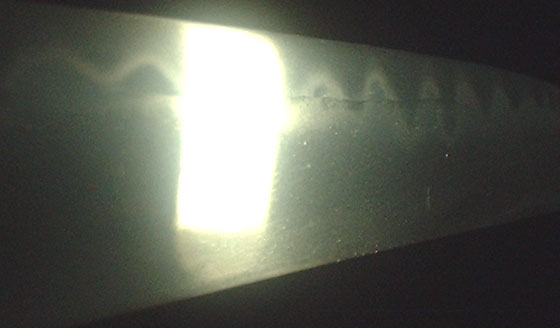
KO-GUNOME = small gunome (by Gassan, 16c.)
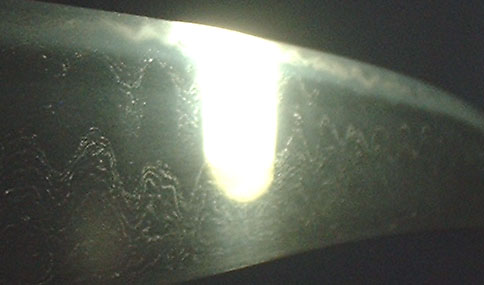
The Ko-gunome pattern in Gassan school is not designed so. The basic pattern
is Suguha (straight), but it becomes Ko-gunome or Notare following after
the waving layer pattern.
SAMBON-SUGI = three cedar trees (a kind of Gunome, by Kanemoto, 16c.)
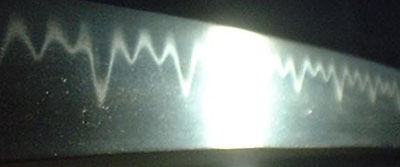
The smith Kanemoto is famous for this hamon pattern. The design becomes
more perfect according to the younger generations.
CHOJI = clove (by Naohiro)

Choji is also one of the oldest pattern. It appears naturally on the sensitive
steel. So we appreciate it.
The Ichimonji school is famous for it. Do not confuse the choji pattern
that is designed by the smiths in Shin-shinto period.
JUKA-CHOJI = double choji (by Naohiro)
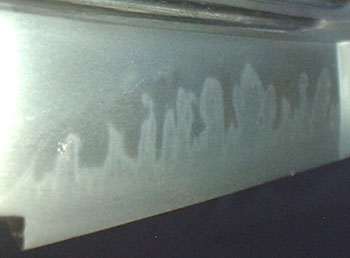
SAKA-CHOJI = steep choji (by Naohiro)
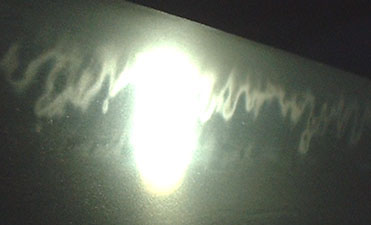
KO-CHOJI = small choji (by Naohiro)
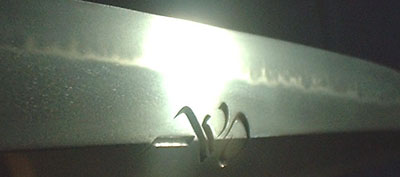
CHOJI (by Osafune Yukisada, 14c.)

This Choji pattern hamon includes some amount of designed work.
NOTARE = wave (by Naoe-Shizu, 14c.)

HITATSURA = full surface tempered (of an unsigned tsurugi)

This Hitatsura pattern is not designed, it comes naturally.
HITATSURA (by Seki, 15c.)

In other words, Hitatsura is a hamon with many Tobiyaki.
HITATSURA (by Yoshiharu in Owari, 16c.)

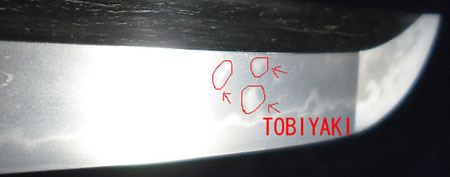
TOBI-YAKI = jumping hamon
It is a part of hamon that jumps away from the main hamon line.

Home > Information, Blade > Hamon patterns