 Nikko
Nikko


February 9 and 10, 2024
Visiting the Tatara furnace in Shimane prefecture
I visited there. I watched only two days. Feb. 9 - it was the third day of their work of smelting. They keep putting sand iron and charcoal into the furnace for three days. Feb. 10 - in the morning, the bellows are stopped. And they break down the furnace and take the big iron out of the bottom of the furnace. It was exciting and amazing.
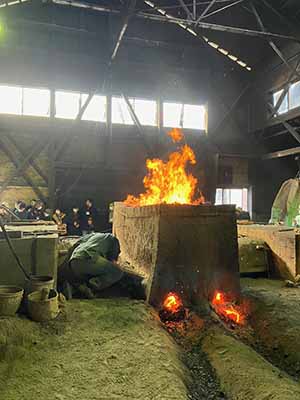
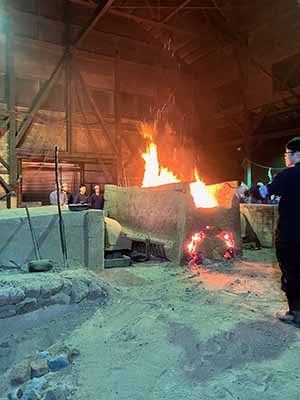
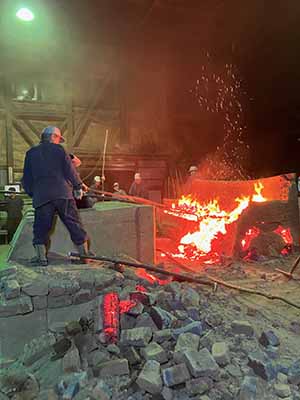
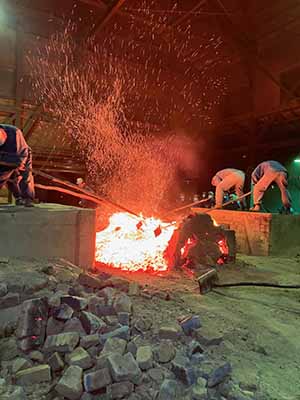
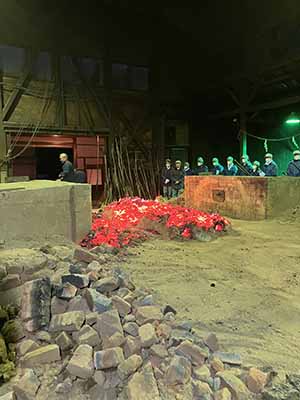
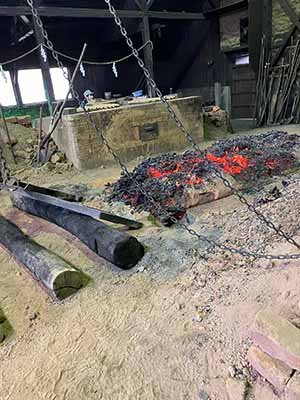
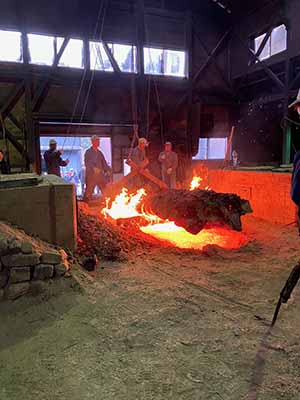
Later, the big iron is broken into small pieces. It is the tamahagane.
January 10th 2018
I went to the Tokyo National Museum to see the O-Kanehira what they say
one of the best Japanese sword.
I have seen it several times in the window.
I don't know who polished it, but the polishing work is not good or horrible
even if it is called an excellent polishing as "Art sword". It
brings up the layer pattern so much, that the utsuri is masked by the visible
layer.
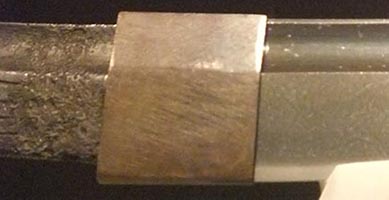
On the other hand, the habaki is excellent. It is very original, made of un-refined copper. The surface is just a remains of filing work. It must be made at the same time when the blade was forged out. It shows that the blade was a simple weapon when it was made. Simple weapon is beautiful, while art sword is ugly. This is the key of the beauty of Japanese sword.
April 24 2015
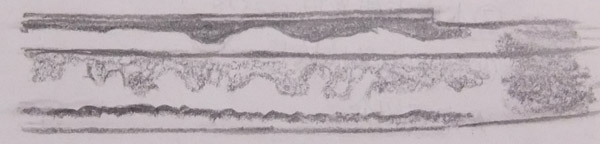
Studying the Yoshiie blade carefully, I found that the core steel appears
in the shinogiji. It must be Kobuse or Makuri steel construction.
In the rough sketch, the steel near the back in shinogiji is core steel.
July 6th 2014
I went to the Chido Museum to see some swords on exhibition. I will introduce two masterpieces in
that.
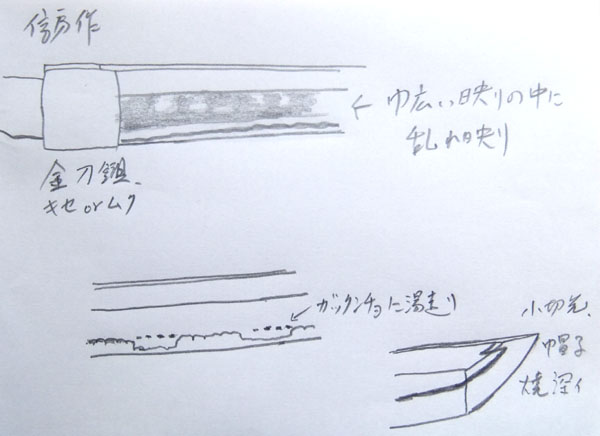
1) Tachi "Nobufusa" - The shape is formed with big fumbari, koshi-sori,
and small kissaki. The steel layer pattern is looking uneven. A large layer
pattern steel and compact layer steel are irregularly appeared. But the
steel quality is very good. The hamon is mainly large particles (nie),
making komidare and ko-choji pattern. The character meets the requirements
to see it in Ko-Bizen group.
A wide utsuri appears along the hamon, following with a clear jifu between
the utsuri and hamon. Additionally, midare utsuri pattern appears in that
wide utsuri. The appearance is fantastic.
Another excellent point of this blade is its kissaki. It is very small
like most of other blades in Ko-Bizen group. But this kissaki has very
enough width of hamon. I am not sure if this is just an original style
or worn. Anyway, such a small kissaki with wide hamon is rare and interesting.
Image from book

Memo by Kokaji
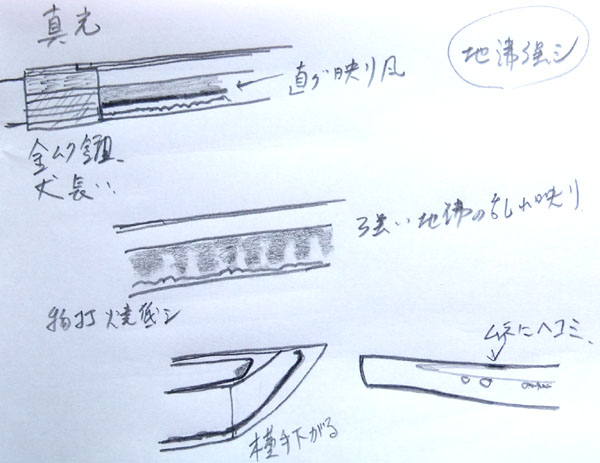
2) Tachi "Sanemitsu" - Some people say it is Osafune school. The shape looks robust with big fumbari, while the kissaki is a little worn. The hamon is ko-choji made of small particles and large particles(ko-nie and nie).
The most impressed point of the blade is its utsuri. It starts as straight pattern following with clear jifu between the utsuri and hamon. Then it becomes a midare pattern utsuri. The midare utsuri doesn't followed with clear jifu, but it is very strongly appears as irregular denseness of steel particles (jinie). That appearance of steel is very beautiful. It is not only beautiful for eye, but it shows the mysterious activities of sensitive steel as well.
Image from book

Memo by Kokaji
November 1st 2013
I introduce a sword that I saw at the Kasuga-taisha shrine in Nara.
Tachi
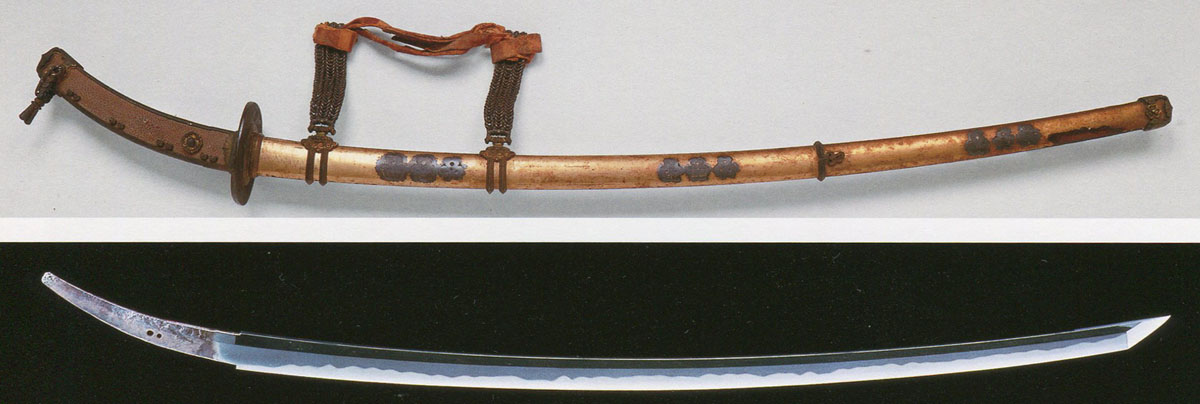
It is originally unsigned. It is unbelievably healthy blade from 12th century.
It has been kept in the shrine as untouchable treasures since it was dedicated
in 12th century, and recently it is re-polished. The blade has full meat
on bevel. The steel is bright and clear. The hamon particles are very bright
and dense, making komidare and choji patterns in straight outline. It is
amazing that the hardened area is full of particles. It looks hard and
dense, and including full of cutting power. The hamon in kissaki is very
wide almost full of kissaki area. The appearances of this blade is quite
different to other blades in that age what we often see at museum and sword
clubs. Most of those blades are very worn.
The person who study old blades in 12th century, like Kobizen, should come to the shrine and study this blade to see how the blade is robust when it was made.
(=> Kasuga-taisha shrine)
Unfortunately, the polishing is the modern style, and its cheap hadori
work breaks the elegance of the blade.
(for information => Why originally no signature on good quality blade?)
October 24th 2012
I went to the exhibition "MEIBUTSU-Treasured Japanese Swords-"
at the Sano Museum. There were many good swords in the window. Especially, I was very impressed
with three Ko-bizen blades displayed side by side. Those were two Naritaka
and one Tomonari.
Ko-Bizen is not a name of one individual school. Its literally meaning
is "old Bizen". Before the early 13th century, there were not
appearing the particular schools like Ichinonji or Osafune. So we classify
such old Bizen blades with the word "Ko-Bizen". Probably there
were several small schools in that age. Therefore, Ko-Bizen blades includes
various characters.
The three Ko-Bizen blades in the exhibition were all masterpieces, and
interesting to study each of them.
1 Naritaka

2 Naritaka

3 Tomonari of Itsukushima shrine

The first Naritaka had a small kissaki and its hamon was ko-midare and ko-choji including many complex appearance.
The next Naritaka was very healthy. Its kissaki was not so small as the
first Naritaka. The shape was very powerful. The hamon was suguha outline
and many choji-ashi. The hamon particles were dense konie.
The Tomonari was very famous as "Tomonari of Itsukushima shrine". It was also very healthy. The shape was powerful and the hamon was suguha outline with many choji ashi made of dense konie. It looked almost just made out, except for the kissaki shape that seemed a little worn. Its character was very different to other Tomonari like Uguisumaru or Tomonari of baronYamamoto.
When I studied those three blades in the window, I thought that the characters we have learned as Ko-bizen blades were characters of worn out Ko-Bizen blades. The healthy Ko-Bizen blades were very powerful in its shape and steady in its hamon.
I believe that the Ko-Bizen blades were made as simple weapon, and never
have tricky appearances. That is the reason why they are so beautiful.
July 19th 2004
I went to the exhibition "Bizen swords" in the Seikado museum.
There were Kobizen, Ichimonji, Osafune and other schools in Bizen province.
All of them were masterpieces.
I started studying from Kobizen to Ichimonji, Osafune ...
Of course Osafune blades are masterpieces themselves. But in the line-up
of the room, Osafune were not as interesting as comparing Kobizen or Ichimonji.
We had to be deeply impressed that Kobizen and Ichimonji are the best blades
in sword history.
Especially, Masatsune, Tsunemitsu, Takatsuna, and Yukimitsu in the Kobizen
school were excellent masterpieces.
Feb. 28th 2003
Some days ago I saw one good blade at a kantei club.
I have met the blade twice in the past. The first contact was about 10
years ago.
Every time it has brought me a fresh impression.
The blade has no signature by shortening, and is attributed to the "Awataguchi"
school.
But the attribution does not matter because the blade is very good. It
doesn't have any title or papers.
The shape of it means 13th century.
Regarding the steel, a little large layer pattern is
covered with full of jinie, and utsuri
appears with quite clear jifu.
The hamon is made of bright nie, and it makes a mild lined kochoji and komidare pattern.
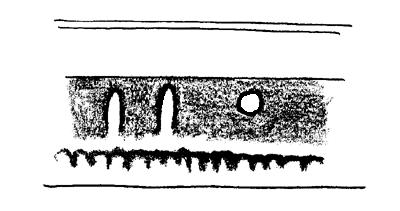
The blade brings a natural and powerful feeling.
Every aesthetic blade have to be ashamed of itself in front of this blade.
I have understood that "Good blade is an instrument to build your
personality up".
We can voyage into the infinite world that has only 3cm height from earth
to heaven.
This blade is a good example of the words by General Yamaoka who was a
leader of the Japanese sword culture before WW2.
"Beauty comes on naturally without wanting it, skilfulness comes on
automatically without designing it."