Ken blade with straight layer pattern (Ken blade A)
Forging the blade
This time he tries a blade with straight layer pattern. So the steel construction is the sandwich style (three layer).

Fold'n welding work for the outer steel - Rough formed steel pieces are picked up. Each of the pieces are formed with uneven quality in itself. Some parts are hard, and other parts are soft. Some parts are rough and other parts are dense. They are rather soft comparing with the core (edge) steel.
The steel is on the work of 8 time folding.
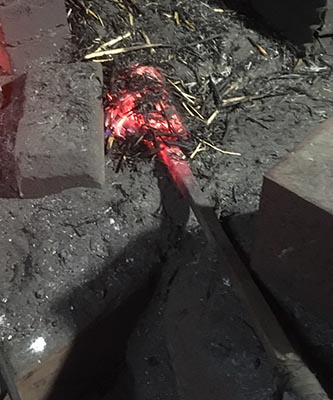
The outer steel is folded 13 times, and then turned 90 degrees to show the steel layer on the surface. And it is cut into two pieces those become the both sides of the blade.
Making the core steel
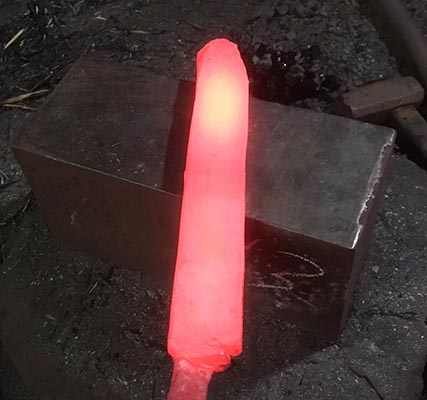
It is on the half way of fold'n welding work. It has been folded 5 times, and will be folded more.
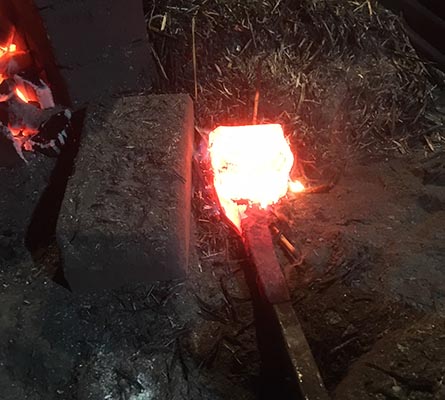
The steel is covered with rice straw ash, and put into the forge again to get the welding temperature.
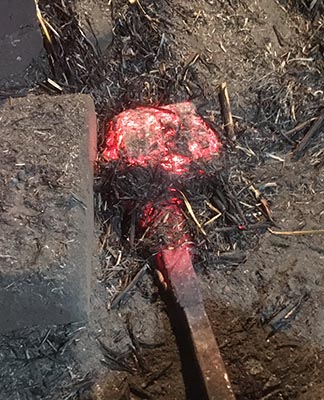
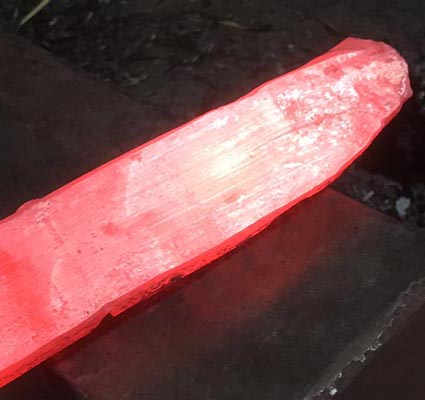
The core steel is forged out after 13 times folding. It becomes the edge of the blade. And this steel block is cut in two. One is for this ken blade, and the other is the ken blade B. So, ken blade A and B are sisters in the meaning of the core steel. =>New sword 1B
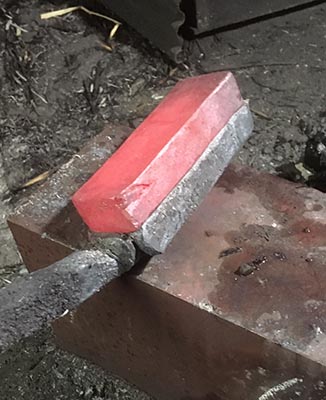
And then, the core steel and two pieces of outer steel, are welded together in sandwich style.
The constructed steel block is roughly drawn out.
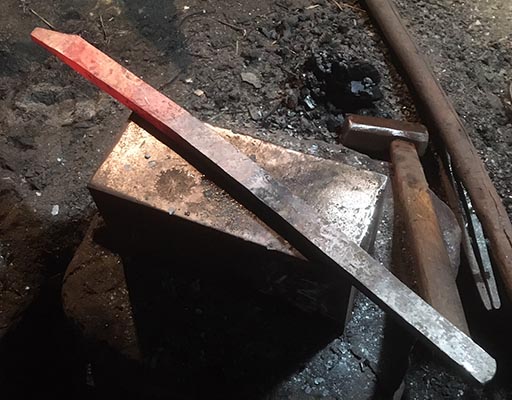
Shaped by hammer work

The the blade is shaped by the plane and files. Then, it is a time to harden the blade.
Clay is put on the blade.

Just after the quenching work
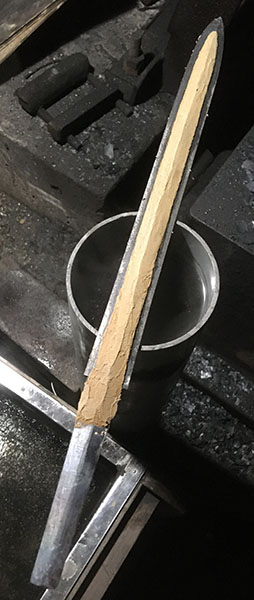
Blade length 35.7cm