Tanto in Kanmuri-otoshi-zukuri
"Naohiro"

Blade length 26.7cm width at the base 27mm thickness at the
base 6mm
style of shape: kanmuri-otoshi-zukuri
The hamon pattern is komidare and small choji, made of konie(small particles)
and nie(large particles). The hamon becomes wider toward the kissaki, and
the particles becomes larger toward the kissaki.
The steel is fine and tight near the hamon, and is a little rough near
the ridge line. The layer pattern is mainly a little large wood grain.

This blade has a steel construction of hyoshigi (two blocks). On this blade, the difference between the two steels is
easy to be seen.
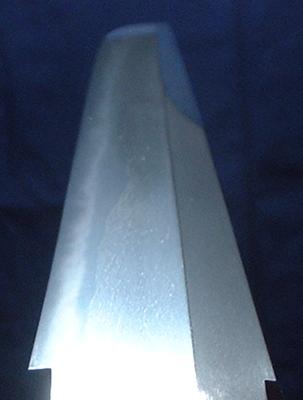
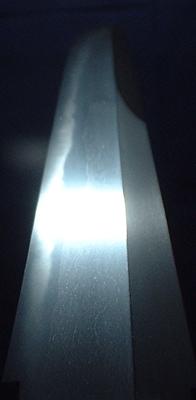
Please watch the photo below, there is a shadow-like deeper colour area
along the hamon. But it is not a shadow of the hamon, the deeper colour area is the cutting edge steel, the shallow
colour area is the back one. The border is come from difference of the
steels as material, not come from the effect of hardened work.
We can see every thing honestly by its good polishing of the classical
style. (=>polishing)
Once there was a happening on this blade in the Keiun
forge.
On the stage of shaping with the rough stone, just after the hardening
work, an apprentice of the smith had ground this blade so much, and broke
the shape. Before he broke it, it had 8mm thickness and 30mm width at the
base. And the hamon line was sharp and hard. Then it was shaped again by
the master .
Now the hamon looks old, because the hamon line has become mild by much
grinding. It is good example to study the inner effect of the hardening
work.
Home > Gallery, New sword > Tanto "Naohiro"