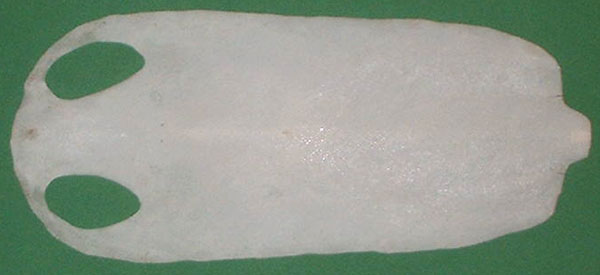
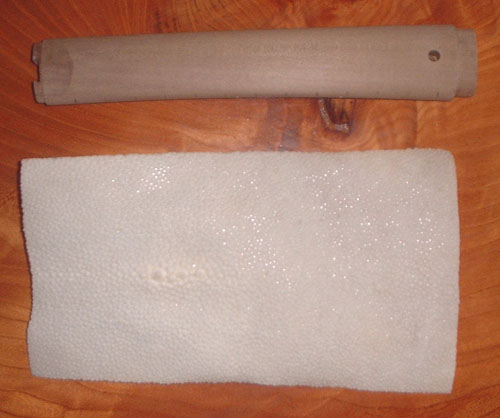
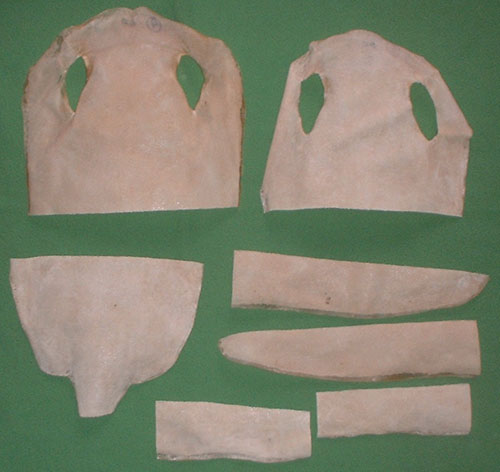
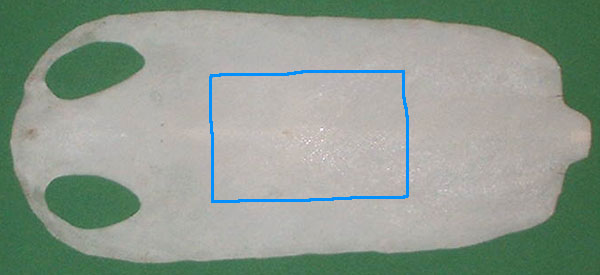
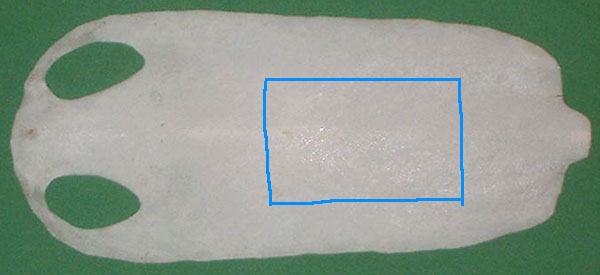
This style is used only for cheap swords. It is small meaning to use ray skin. Sometimes there is a line on the reverse side to trick it for Marugise. Usually it is made of the second pieces of ray skin.
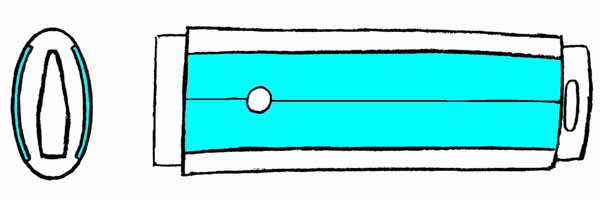
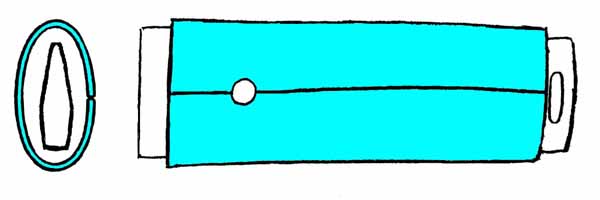
Maru-gise (Round wrapped)
It is common on good quality swords. Usually the seam is at the centre of reverse side. Sometimes it can be placed near the back or near the cutting edge.
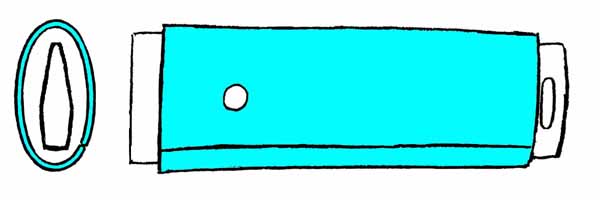
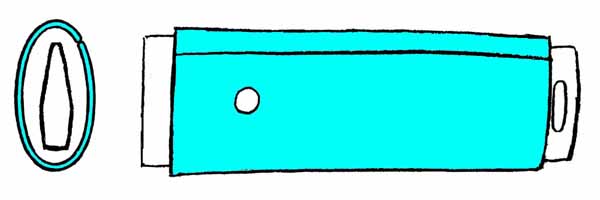
An old handle wood with ray skin wrapped by the round wrapping style.


Maedare-gise (Round and Half)
This style is the most tough. But it was not common in old days. Because, it is not easy to make a good work, and expend much ray skin. We can find this style of handle only on the swords in feudal lord collections, or some Samurai's who prepare his sword carefully.
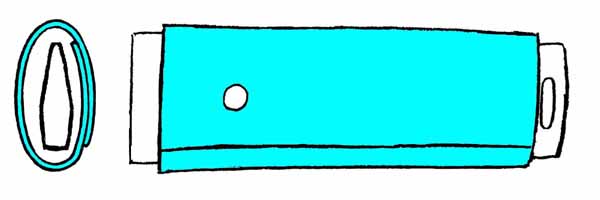
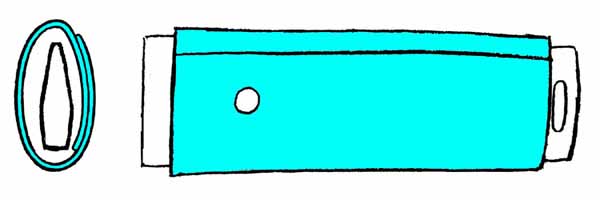
An actual example of handle with the ray round and half wrapping. The kashira is a buffalo horn.




An example of old handle that has excellent work of round and half ray skin wrapping
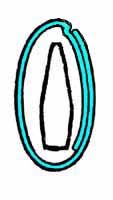
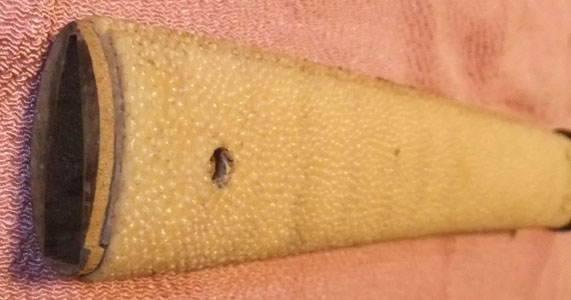
The ray skin fully covers the handle length. The fuchi is put on the rayskin, and the wood panels are settled on the ray skin to get even level.
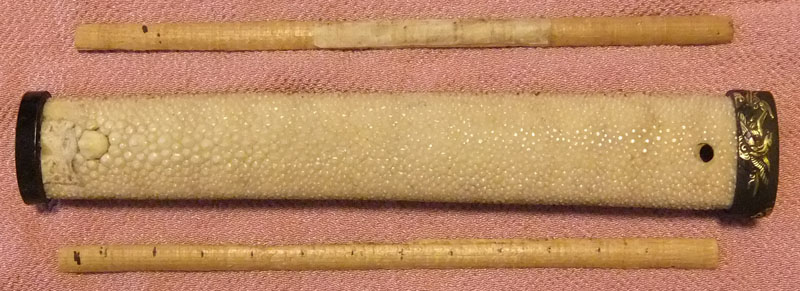
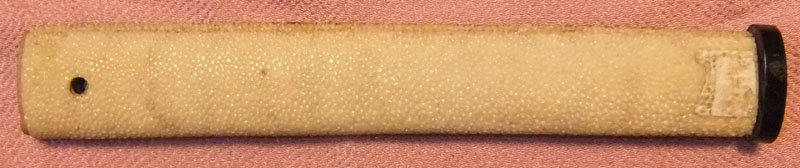
The glue between the ray and wood doesn't work now, and the ray skin is a little shortened by aging of hundred years.
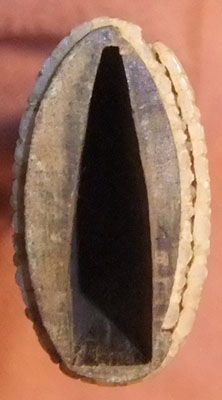
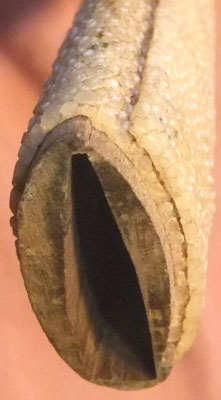
In Koto period, it is common to harden the ray skin with urushi lacquer, because ray skin is weak against the rain. White ray skin is used on parade swords and noble's swords.
In Shinto period, white ray skin became more popular. The Edo government took the policy of national isolation, and they had kept peace over 200 years. I wonder if ray skin became more expensive, and people forgot to prepare their sword for battle field.
We have received a question from a customer.
Do the craftsman prepare the mune and ha area on the ray skin with paper panels?
Or does he do tsukamaki directly on the nodules?
(tsukamaki = the work wrapping with cord)
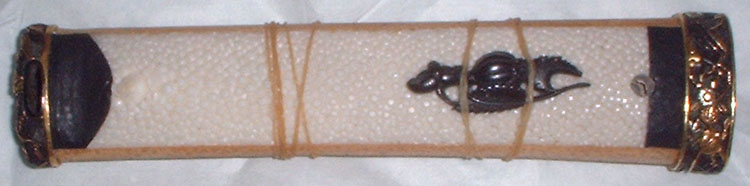
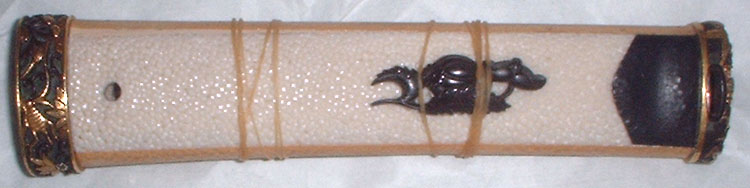
Usually the mune and ha is prepared with paper or wood panels to make a smooth surface for tsukamaki. The level between the fuch/kashira and the wrapped cord surface must be even. Some craftsman says, the panels are necessary to make a proper surface on ha/mune. Such a method is common in Edo period.
A foundation work of tsukamaki.
The ha and the mune are wood panels. The start and the end are black papers. The ray skin is the round and half (maedare-gise).

Before 16th century, in Koto period, the method seems a little different.
I studied some old mounts from the Koto period. The tsukamaki surface on ha and mune has small risings of nodules. In other words, we can see the nodules over the wrapping. That means the handle under the wrapping is not smooth, it still has nodules. So we can see that the handle has no panels on its ha/mune.
It is not easy to make a even surface without panels. The work of ray skin wrapping has to be done more exactly than the case using panels.
The directly wrapped handle is better to swing the sword. The wrapped cord is hard to move, because the nodules bite into the cord. Therefore the direction of the ray is important.