Episodes by Kokaji
Our smith Kokaji introduces several funny episodes. We hope you enjoy them.
1) Tempering crack at kissaki
When Kokaji was still an apprentice in his teacher's work shop.
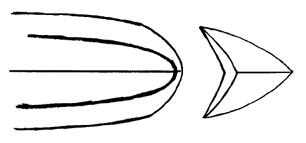
One day the teacher tempered a spear that had a diamond section. Then the
apprentice polished it with the rough stone to see the hamon. That was
a fine suguha, and there was a sharp crescent line at the point.
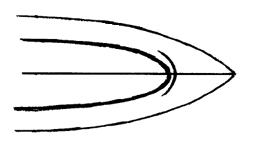
The teacher took the blade to see the result and said "No good".
The apprentice asked him what was the reason of "No good"?
He pressed the tip to concrete floor, instead of an answer. Not hit, just
pressed.
The tip was broken easily, and he said the apprentice "Look".
The shape of the removed piece was as sharp as a piece of ice.
It was so nice that the apprentice wanted to keep it.
2) Mizukage
One day, Kokaji visited a master polisher to receive a tanto blade that
was made by himself and had been polished by the master. In the master's
parlour, he came across a student of the master, who had finished apprenticeship
and worked independently. Therefore there were three persons in the room,
Kokaji, the master, and his student. They started studying the fresh polished
blade together.
When the student studied the blade, he asked his teacher,
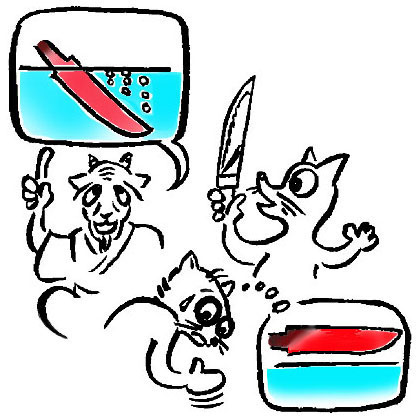
"This blade has Mizukage, was it re-hardened?"
The master answered,
"No, it was not re-hardened. The smith put the blade with 45 degrees
into the water at hardening."
The student,
"I understand."
The smith intruded into their conversation,
"I am sorry, I didn't harden it such a way. I just put into parallel
with water surface."
The teacher told his student,
"This is mizukage. He certainly put blade into with 45 degrees, even
he doesn't remember."
The smith said,
"...Probably, ...I might unconsciously act so."
Then, all the persons in the room got happy.
---------------------------
Be careful. Sometimes we face similar situations in Japan.
(=> Poetical terms, mizukage)
3) Step-hardening
Kokaji was shown an old Naginata by a customer. It was very old, may be
from Kamakura period or Nambokucho period, but very healthy with its meat.
It was a little shortened.
The owner was proud of the blade. But Kokaji found that the hamon was a
step-hardening, above the monouchi was a re-hardened new hamon. The owner
was disappointed with that.
Sometimes we find such work on old blades.

The original hamon disappears before the new hamon. Then the reproduced
hamon starts with mizukage.
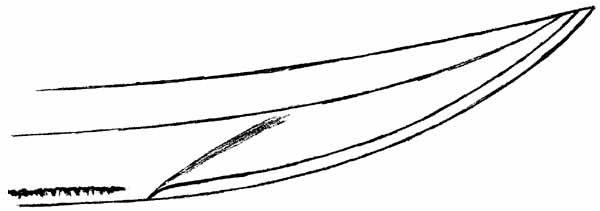
This blade was polished very well by the modern style. Of course the hadori
(white pattern) was made as one continuing hamon pattern. So it was a little
difficult to break the trick of step-hardening for beginners.
Anyhow, it is impossible to connect new hamon to the original hamon.
4) Grinding Iai master's blade
Kokaji had made a blade for an old Iai master who settled an exact order
for the weight.
One day the old man brought the sword to kokaji's forge again and asked
to grind the blade lighter because it became heavy for him.
Usually Kokaji doesn't accept such a terrible order, but finally he accepted.
He seemed it empty to educate such a respectable old man.
The blade was ground with the rough stone, and checked the weight by the
old man swinging it.
The work repeated again and again until the old man agreed with the weight.
They didn't know how much steel had gone.
When the blade was re-polished, the hamon Kawazuko-choji before had changed to Komidare with small Tobiyaki.
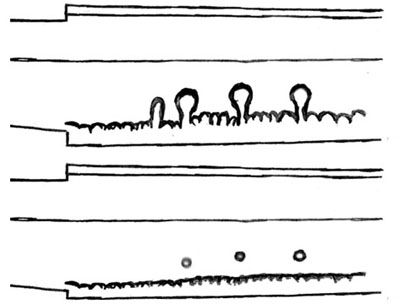
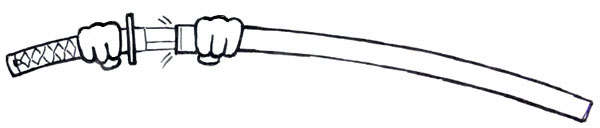
The old man tried to sheathe the blade into the scabbard, but it couldn't
run to the end.
The curvature became smaller, and it didn't fit to the old scabbard.
5) Very bad inlay work on the tang
At some Kantei game of sword club, Kokaji saw a very good tachi blade with
an original length.
He was sure it was made in 12th century.
When the handle was taken off he was very surprised.
Because, the tang was originally unsigned and kept an original shape, but
it had a gold inlay that was made recently.
It was two letters of the name of "Yoshikane" and the signature
of professor "K.H".
It meant that the professor "K.H" attributed the blade to "Yoshikane"
(in Kobizen school).
This gold inlay was a very big flaw even if it was beautiful. The originality
of this tang was broken by the inlay work. Serious sword lovers never do
such work because they respect blades.
The person who produced this inlay does not love swords, only plays with
them.
-------------------------------------------------------
Generally a gold inlay of a smith's name has to be done at the same time
of shortening the blade, being sorry the signature disappear.
Sometimes, old Hon'nami put their attributed name with gold inlay on the shortened tang.
An attributed name has to be done with lacquer.
A red lacquer is on the original unsigned tang. A gold lacquer is on the
shortened tang (O-suriage).
6) An excellent re-polishing
Once ago around 1980, a collector had "Moritoshi" tachi of Ko-Aoe
school.
It was very good blade and so was its polishing. The polishing was very old as 100 years or so.
The blade steel was full of clear jinie and a large layer pattern flowed with misty utsuri (shadow of hamon). The appearance of steel particles looked like sands through the water. The hamon was mild konie making a komidare pattern and the particles twisted on the hamon along the large wood grain. The blade moved us with its profoundly gentle, feeling.
But unfortunately the blade had deep rust on the cutting edge, midway along
its length. The owner hesitated to re-polish it being afraid that the shape may be
broken. In the end he brought it to Hon'nami to ask for a re-polish.
After some months, the blade had been completed. Kokaji and the owner were
scared to look at it but the shape had not been broken. They couldn't even
imagine how the Hon'nami ground out the rust and they believed he'd worked
a miracle.
They were also surprised by the finish on blade surface because the whole feeling
of the blade had been changed by his modern polishing style. The steel
was filled with silver jinie making a very small wood grain. They could
not find any large layer pattern nor utsuri. The hamon particles became
bright and strong. The old, gentle blade had become a strong, shining one.
Anyhow, the new polishing was excellent, but they missed the original polishing
style.
7) An interesting story of polishing styles
There was an old polisher who was very famous for his modern style polishing
work.
A blade polished by him changed dramatically. It had a shining steel surface,
visible layer patterns, mirror finished shinogi-ji and an attractive white
hamon.
His thumb made a miracle.
It seemed like the blade had jumped two or three grades up the rankings.
He was always a leader in the fashions of sword polishing.
Even today, many polishers are afraid to re-polish one of his jobs, because
its attractive appearance would certain diminish in any polishers hands.
His polishing system included many secret techniques and his modern style polishing was in high demand.
However the masterpieces hidden away in his own collection were all polished
in the old classical style.
-----------------------------------------------------------------
We don't know if this story is true or not. But it illustrates the meaning
of polishing style clearly.
HADORI polishing is good for business, SASHIKOMI is good for loving.
8) An O-suriage katana "Shizu"
Kokaji was shown a good katana blade by a friend of him. The friend asked
him to answer the name of smith without putting off the handle.
They often play such Kantei game with close friends.
Kokaji answered "Kiyomaro".
The friend said "No (different age)".
Then the handle was put off. The tang was O-suriage, but it already had
a paper attribute to "Shizu".
(Kiyomaro ; 19th century, Edo city)
(Shizu, Saburo Kaneuji ; 14th century, Mino province)
The friend was proud of the Shizu blade, and was going to have it re-polished
to challenge higher rank paper.
He told kokaji to study the mild temper line that never seen in Shin-shinto.
Kokaji thought the blade had been much ground to confuse it so old, and
the tang also reshaped to confuse with O-suriage.
They studied the blade carefully and discussed, but never got conclusion.
Some months later, the friend told kokaji that the blade was polished up
by a famous polisher and submitted to shinsa.
The friend said,
"It is secret, but the polisher whispered me the blade is Kiyomaro".
Then, Kokaji never heard the result of the challenge for higher rank paper.
-------------------------
Only polishers can see the real face of blade before make up.
9) Cast iron tsuba
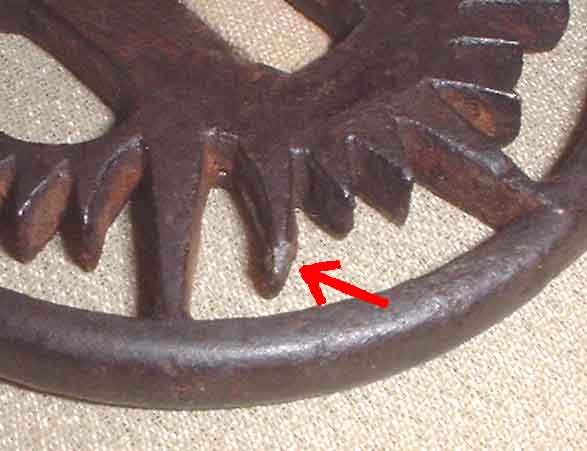
Kokaji found an iron tsuba at an antique dealer. Its design was that he was looking for so far. But it looked like cast iron by studying it in his hand.
It was a casting copy of a good Owari tsuba. Cast iron tsuba is far cheaper
than steel tsuba, even if the design is so good. The difference of their
prices is ten times or more in the market. Cast iron tsuba is a toy and
never could be a weapon.
He said to the dealer that he was sorry for that tsuba because of it was
cast iron. The dealer didn't agree with him, because the dealer was sure
it was steel. Then they studied it carefully but never agreed. There was
no seam mark on the cut out surface. The seam mark caused by casting work
had been removed by filing carefully.
The dealer said, "I believe this tsuba is steel, so please break it.
If it can not break easily, please buy it."
Kokaji didn't want to break it in two pieces, so he settled it on vice
and punched a small part of it. A small amount of metal was broken off
easily. It never bent. Finally they got the solution. It was a very cast
iron tsuba. It was so brittle.
10) Break army officer's blade
Now, I remember an episode of my teacher
Naohiro the third. I heard that from his younger brother who was a polisher and
worked together with the Naohiro.
-----------------------------------------------------------------
In the time WWII, the brothers were around 30 years old.
An army officer brought a blade within shirasaya to the Naohiro forge to
ask producing army mount for it.
He was going to Manchuria, so he needed a new sword preparing for future
combat.
The blade was a modern steel made with
sambon-sugi hamon.
The hamon was not so wide, but it looked very shining like a mirror, and
so was the steel.
Naohiro told the officer that the blade was
not suitable for his army sword because it seems brittle.
The officer became angry with Naohiro's words, and told him forcefully
if he could break the blade immediately.
The brother of Naohiro was very afraid what would happen if Naohiro couldn't
break it.
Naohiro struck the back of the blade against the stone steps at the entrance
of forge.
The blade was broken in two pieces.
Then the officer cooled down his anger, and
got satisfied with the advice Naohiro had given.
The brother of Naohiro had almost lost his spirit, and then felt relieved.
Then, the officer ordered Naohiro another sword to bring to Manchuria.
Later, the brother asked Naohiro, why he created such a threatening situation
by himself.
Naohiro answered with indifferent face that he was sure the blade would
be broken.
-----------------------------------------------------------------
The brother told me that Naohiro the third was really amazing.
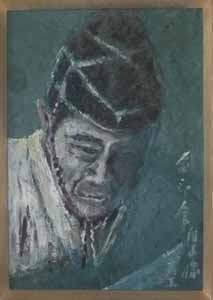
Self portrait of Naohiro the III
11) Crack in hamon disappeared
One day, Kokaji was shown a katana blade by his friend. That was Osafune
Kiyomitsu with bright suguha hamon, and engravings of grooves and Sanskrit
letters. It was a nice blade at first sight. But, it had a crack in hamon
at the middle part of the blade. It would be still good blade, though the
value was not high in market.
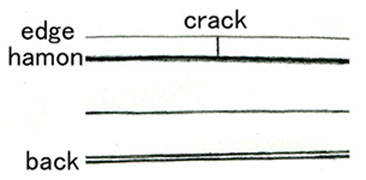
Some months later, another friend brought a Kiyomitsu katana again. It
looked same to the cracked Kiyomitsu, but it was newly polished by brilliant
modern style this time. Kokaji studied the blade and confused, if it would
be the same blade to the Kiyomitsu he saw some months ago. The shape, hamon
and engravings were the same, but he couldn't find the crack by any searching.
Studying carefully, he found a strange appearance at the middle part of
the blade. It was a little difficult to be found, because of the very white
hadori. The bright hamon line disappeared at the middle part, and the bright
hamon area also became dark around the part. It could be considered some
effect of heat. Kokaji didn't know what happened on the crack, but he was
sure it was the Kiyomitsu he knew.
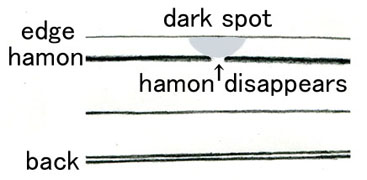
A good quality blade had been castrated.
12) Sword for Kamikaze pilots
This is another episode of Naohiro the 3rd in his young working days. He
named "Keiun Naotsugu" until his father Naohiro (the 2nd) retired.
"Keiun" means lucky cloud. So many air troopers liked his blades
to put into their army sword as lucky charm. Usually pilots didn't carry
their sword into cockpit. But in war time, they rode on with their sword
together. Especially on his last flight "Kamikaze attack", because
a sword is necessary for funeral in Japan.
The sword for air troopers were special ordered, because lighter weight
was necessary to carry into cockpit. Keiun Naotsugu made swords for them
with his special work. The sword looked normal shinogi-zukuri style katana
with grooves on shinogi-ji. But the dimension was almost hira-zukuri with
yokote line. He reduced the weight of blade by creating such a shape. He
accepted many orders from air troopers.
During WWII, many of "Lucky cloud" blades might sink in the Pacific
Ocean together with their owner Kamikaze pilots.
------------------------------
Once, retired 3rd Naohiro told me this story.
13) Overlooking a masterpiece
An old person brought a sword at a sword club. He was handed down the sword from his father, but he had small knowledge about sword. He became old, and he was thinking to release his father's sword. Then he wanted to know what the sword is.
The members studied the sword one after another. It was a long tachi blade
of 75~80 cm long without signature. Kokaji appreciated it as masterpiece,
but no one agreed with his opinion. They judged it as a weary blade in
15th century, and the smith was in the school like Uda or so.
Their opinion on the study was,
1, The shape is weary.
2, The steel is rough layer pattern.
3, The hamon is non-ordered pattern with uneven large particles.
4, The file work on the tang is not clean.
In conclusion, the work is not skilful. The blade quality is not very high,
and so is the value.
Then, the old man brought back the sword.
Some months later, Kokaji went to a sword shop. He was shown a typical Ko-Bizen blade there.
1, The shape is koshi-sori with big Fumbari. The kissaki is small.
2, The steel is a large wood grain layer pattern with jifu-utsuri.
3, The hamon is natural ko-midare pattern with much nie (large particles).
4, The tang is kijimomo style with plane finish (sen-suki). But originally
unsigned.
It was a masterpiece, and healthy as 800 years old blade. In a moment,
he found that it was The blade at the sword club. He was told the story
how the sword came to the shop. Then he knew that the father of that old
man was a famous collector. He had handed down the best sword to his son.
Kokaji studied the blade again carefully. The condition of the sword never
changed to that seen at the sword club, but the impression is very different.
It was one of the best blade he had ever seen.
This time, no one doubts that it is a masterpiece of Ko-Bizen.
14) Experiment of sharpness "Chinese sword vs Japanese sword"
Once Kokaji made a custom sword for an old collector. It was a wakizashi,
but very unique with broad width and big thickness. It was heavier than
normal long sword. The collector told Kokaji an episode of his experiment
about with Chinese sword and Japanese sword.
One day in WWII when the collector was young, he got an idea to test sharpness
of Chinese sword and Japanese sword. He had a Chinese sword like this.

Such swords were common in that time. He settled the Chinese sword on the
vise, clamped the tang tightly with cutting edge upward. Then he swung
down with his Japanese sword against it. The Japanese sword cut into the
edge of the Chinese sword. The edge of Japanese sword was harder than that
of Chinese sword. He was proud in his mind of the superiority of Japanese
sword.
Then, he changed the position of swords opposite, settled the Japanese
sword on the vise, and swung down with Chinese sword against it. This time,
Japanese sword broke off in two pieces.
Home > Information > Episodes