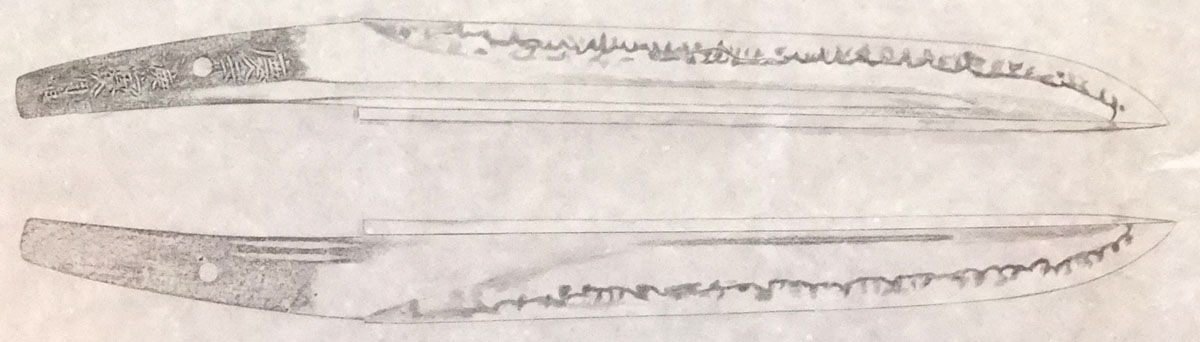
A customer brought us a tanto.
The tanto had been sold by us to him without polishing some months before. We usually don't sell naked blades in such stage, but he wanted it so much, then we agreed.
He brought it to his friend who was an amateur craftsman for polishing, making habaki and shirasaya. Then the tanto had finished up. Then the owner brought it to us to show the result.
The blade was fully polished up by the modern style, but the shape was unbelievably destroyed. The owner had been told by the craftsman that he found a flaw in the hamon around the lower part of the blade, and completely ground it off.
When the owner showed us the blade, not a joke, it really looked like this.

The steel was black shining, and the hamon was simple suguha with some ashi that was seen under the very strong hadori. It looked dull blade, even if you ignore that terrible shape.
The owner asked us to re-polish it, and we accepted his request to save the blade. The mission also interested the smith to study the inner face of blade. The blade was re-shaped by the smith himself. He ground the blade very much to recall proper shape, but kept the tang original. The shape was changed, so the old habaki and shirasaya were thrown away.
It is polished by the smith. The both machi became small, and the engravings became shallow.


The engravings suggest how the steel was ground off.
It is a good example to see the inner face of the blade.
Hamon
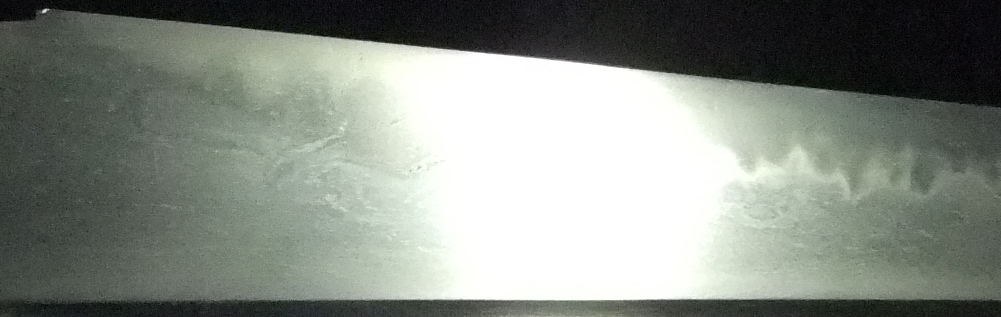
Close-up of the kinsuji
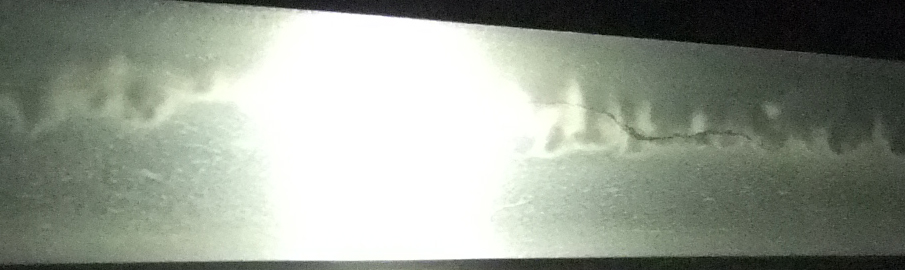
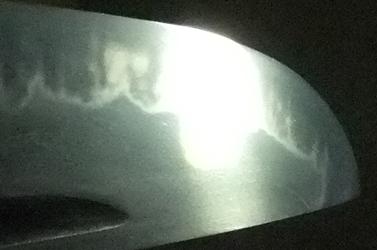
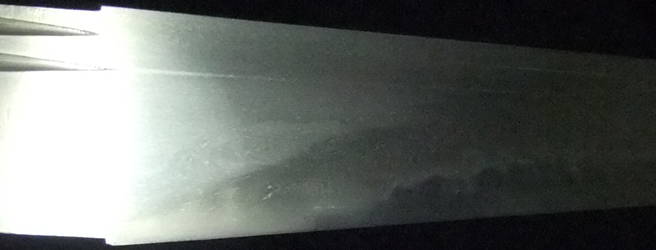
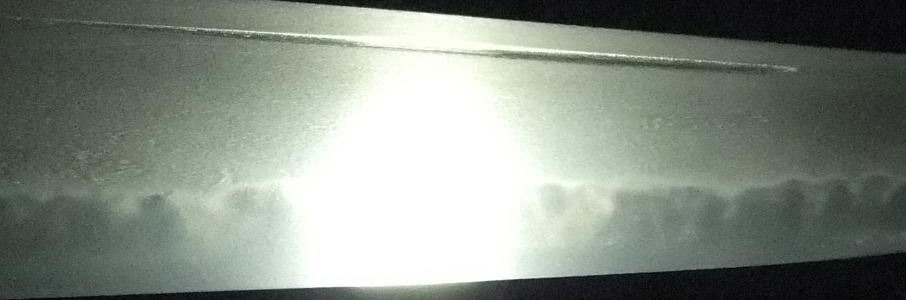
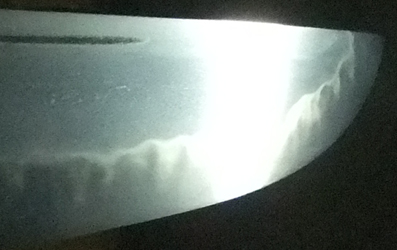
We couldn't find such many ashi nor kinsuji before. They may have appeared by much grinding. The starting of hamon has become thin. The steel particles has become visible. On the whole, the activities in the blade come up more than before. It seems that a dull blade has turned to fine one. The changing may be not only caused by the difference of finishing styles.
Sketch of hamon